For decades, biocomputing existed only in academic papers and research lab demos. That changed in 2025.
Cortical Labs, the Australian biotech company behind the viral “DishBrain” experiments, has launched CL1 — the world’s first commercially available biological computing platform. For the first time, a research institution, pharmaceutical company, or university can purchase a machine that runs on living human neurons rather than silicon transistors.
This is not a prototype. It is a product. It costs $35,000.
What You Are Actually Buying
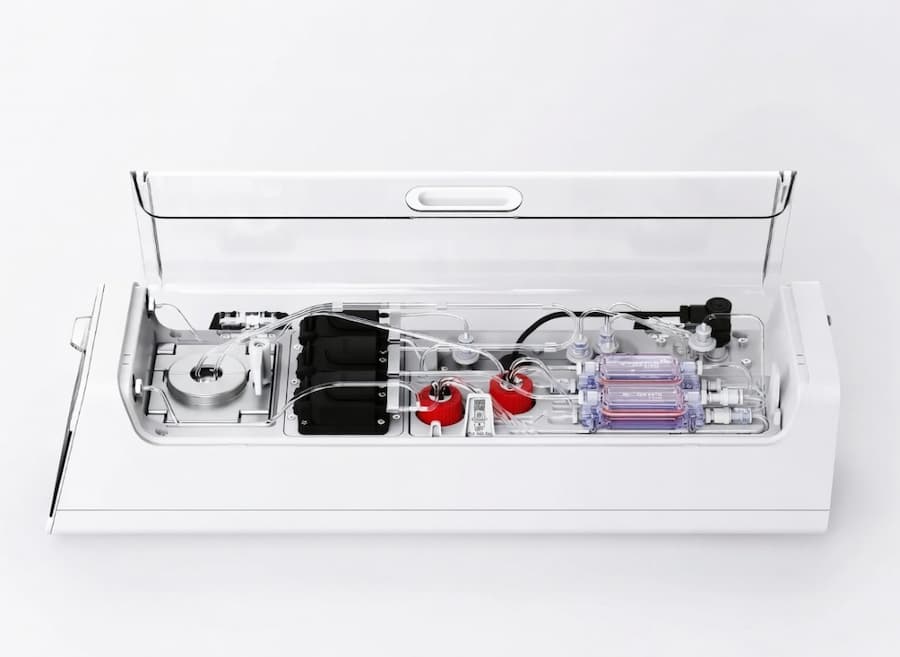
The CL1 is a self-contained desktop unit with onboard life-support hardware. Inside, it maintains a living culture of 800,000 lab-grown human neurons — donor-derived and interfaced directly onto a silicon chip via a multi-electrode array.
The unit is self-sustaining: it manages nutrient delivery, temperature regulation, CO₂ levels, and waste removal autonomously. Neurons remain viable for up to six months. When a batch expires, it is replaced — and because cells are donor-derived, different batches can be sourced with specific genetic profiles relevant to a given research use case, such as cells carrying Alzheimer’s-associated mutations or epileptic cell lines.
Researchers interact with the system through software, with sub-millisecond response times. For labs that cannot justify the hardware cost, Cortical Labs offers remote access through a cloud platform — Wetware-as-a-Service — at $300 per week.
What the machine offers is not raw computational speed. It offers something different: adaptive, low-power learning that no silicon chip currently replicates efficiently. The neurons reorganize themselves in response to input. They do not need to be programmed — they learn.
From Pong to Product
The commercial launch follows a research trajectory that gained global attention in 2022, when Cortical Labs published a landmark paper in Nature Electronics demonstrating that a neural culture could learn to play Pong. The system — then called DishBrain — was not programmed with rules. It received feedback signals when the paddle missed the ball, and feedback when it connected. Within minutes, the neurons self-organized around the task.
The team subsequently demonstrated the same architecture learning DOOM, a substantially more complex three-dimensional environment requiring spatial awareness and navigation. The jump from Pong to DOOM was not about the games. It was a proof that the learning generalized.
CL1 is the commercial packaging of that architecture. A standardized, reproducible, purchasable platform built on the same principles.
Who Is Buying It
The primary market for CL1 is not general computing. It is research.
Pharmaceutical and biotech companies represent the most immediate buyers. Because the neurons in CL1 are human-derived, the platform can model neurological conditions — Alzheimer’s, Parkinson’s, epilepsy — in ways that animal models cannot. Unlike preclinical models with static behavior, CL1 allows researchers to stimulate cells dynamically and measure functional restoration in real time. In one published study, epileptic cell cultures showed measurably improved learning after antiepileptic drugs were applied — directly bridging computation and biological response modeling. Drug candidates can be tested against a living human neural substrate before animal trials, potentially compressing timelines and reducing the high failure rate of neurological drug development.
Academic neuroscience labs gain a tool for studying how biological neural networks learn and adapt in real time, without the ethical and logistical constraints of working with primary human tissue.
Defense and intelligence agencies have already shown interest. In-Q-Tel, the CIA’s venture arm, invested in Cortical Labs — a signal that wetware computing has applications in low-power autonomous systems, edge intelligence, and adaptive decision-making under resource constraints.
For all of these buyers, CL1 offers something that no GPU cluster can: a living, learning biological system that runs on roughly 20 watts.
The Energy Case
The timing of CL1’s commercial launch is not incidental. It arrives at a moment when AI’s energy consumption has become a mainstream concern.
The International Energy Agency reported that data center electricity demand is rising sharply, driven in large part by the compute requirements of large AI models. A single training run for a frontier model can consume megawatt-hours of electricity. Inference at scale is not much better.
The CL1’s low operating power is not a marketing claim. It is a consequence of biology. Neurons are extraordinarily efficient processors — the human brain, running approximately 86 billion neurons coordinating in real time, consumes roughly 20 watts total. CL1’s 800,000-neuron culture operates at a fraction of that. Evolution spent hundreds of millions of years optimizing that number.
Silicon, by contrast, is fast but wasteful. It processes enormous volumes of data per second but generates heat, requires cooling infrastructure, and scales its power consumption with its workload in ways that biology does not.
CL1 does not compete with GPU clusters on throughput. It competes on a different axis entirely — one that the AI industry is increasingly being forced to care about.
What Comes Next
The launch of CL1 as a commercial product creates a new category. Categories invite competition, standardization, and iteration.
Cortical Labs is not the only group working on wetware computing. Johns Hopkins, MIT, and several European research consortia are developing organoid-based computing platforms with increasing neuron counts and complexity. The trajectory points toward systems with millions of neurons, then tens of millions, operating on biological substrates with increasing cognitive capability.
As complexity increases, two things become simultaneously more valuable and more urgent: capability, and ethical frameworks for governing it.
At 200,000 neurons, current scientific consensus holds that CL1 does not possess consciousness or subjective experience. But the honest acknowledgment is that neuroscience lacks reliable tests for consciousness at any scale. As organoid complexity grows, the field will need to answer questions it has historically avoided: what moral status, if any, do biological computing systems hold? Who is responsible for their welfare? How do we regulate their creation and use?
Cortical Labs has stated publicly that these questions are taken seriously internally, and has engaged bioethicists as part of its development process. That is a start. It is not yet an answer.
The Bottom Line
The significance of CL1 going on sale is not that it will replace your server rack. It is that biological computing has crossed from research to product — from proof-of-concept to something you can order, receive, and run in a lab.
That crossing matters. Products iterate. Products find unexpected applications. Products attract capital, talent, and competition in ways that academic papers do not.
The era of biocomputing is no longer coming. It has arrived — in a white desktop chassis, running on 20 watts, growing neurons in a dish.
Sources: Kagan et al., Nature Electronics (2022); IEA Electricity 2024 Report; Cortical Labs product documentation; Shannon Cuthrell reporting.