Every morning, hundreds of millions of people unlock their phones by holding them up to their face. In airports across the world, travelers walk through gates that verify identity by scanning the pattern of their iris in under a second. In hospitals, patients are identified by their palm veins before receiving treatment. In some cities, cameras track individuals through crowds using gait recognition — the distinctive way a person walks — even when their face is obscured.
Biometrics — the science of using biological characteristics to identify people — has quietly become one of the most pervasive technologies in the world. It is also one of the most contested. The same properties that make it powerful make it irreversible: you can change a password, but you cannot change your fingerprints.
Understanding what biometrics is, how it works, and where it is going has become essential knowledge for anyone living in a world increasingly governed by identity.
What Biometrics Actually Measures
The word biometrics combines the Greek roots for “life” and “measurement.” At its core, it is the automated recognition of individuals based on their biological and behavioral characteristics.
Biometric identifiers fall into two broad categories.
Physiological biometrics are based on physical features of the body: fingerprints, facial geometry, iris and retinal patterns, palm vein structure, hand geometry, and DNA. These are largely fixed — they do not change significantly over a person’s lifetime (though aging, injury, or disease can affect them).
Behavioral biometrics are based on patterns of behavior: the rhythm at which a person types, the way they move a mouse, their gait, their voice, the pressure they apply when writing. These are more fluid — they can change with mood, health, or context — but they are also harder to fake, because they require sustained performance rather than a single static measurement.
Both categories rely on the same fundamental principle: that individuals vary in ways that are measurable, distinctive, and stable enough to be used for identification.
How a Biometric System Works
A biometric system has three core components, and understanding them clarifies both its power and its limitations.
Enrollment is when a person’s biometric data is first captured and processed. A fingerprint scanner reads the ridge patterns of your fingertip; a camera maps the geometry of your face; a microphone records the unique acoustic properties of your voice. This raw data is processed by algorithms that extract a template — a mathematical representation of the distinctive features — which is then stored.
Matching is the verification or identification step. When you present your fingerprint or face to the system, a new template is generated and compared to the stored one. Crucially, the system does not look for an exact match — biometric readings always vary slightly due to angle, lighting, moisture, or aging. Instead, it calculates a similarity score and compares it against a threshold.
Decision is where the threshold matters enormously. Set it too high (require very close matches), and the system will frequently reject legitimate users — a problem called the False Rejection Rate. Set it too low, and it will accept impostors — the False Acceptance Rate. Every biometric system is a calibration between these two types of error, and the right balance depends entirely on context. Airport security tolerates more false rejections to minimize false acceptances. A phone unlock favors the opposite.
The Fingerprint: Where It All Began
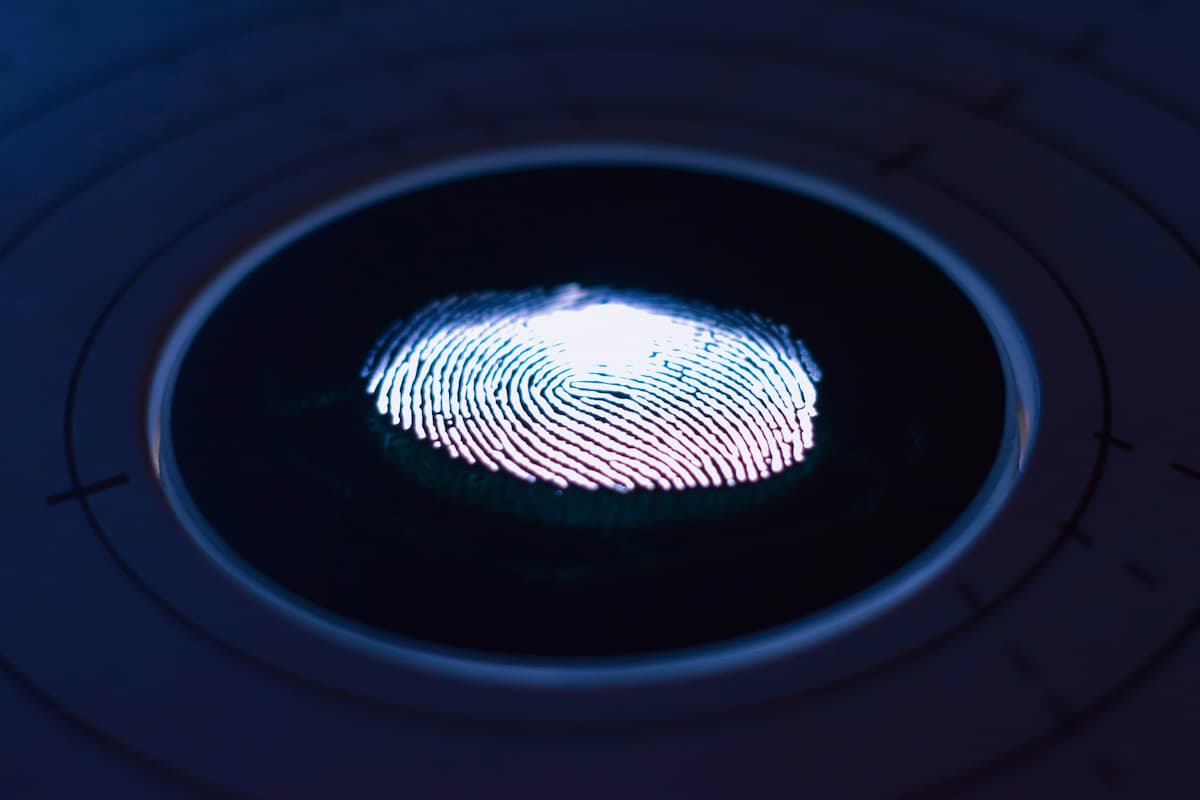
Fingerprints are the oldest and most widely deployed biometric identifier. Their use in criminal identification dates to the late 19th century. By the 20th century, fingerprint databases had become standard in law enforcement. By the 21st, fingerprint sensors had shrunk to fit beneath smartphone screens.
The technology has evolved dramatically. Early fingerprint scanners used optical sensors — essentially cameras photographing the surface of a finger. Modern devices increasingly use ultrasound-based fingerprint scanning, which reads deeper into the skin’s layers rather than just the surface. This improves accuracy by capturing a three-dimensional map of the fingerprint structure, reduces sensitivity to dirt or moisture, and makes it significantly harder to fool with fake prints.
Ultrasound-based scanning has become a game-changer for touchless authentication, making systems faster and more accurate by reading structural information that a photograph cannot replicate.
Facial Recognition: Speed, Scale, and Controversy
No biometric technology has grown faster — or generated more controversy — than facial recognition.
The basic principle: a camera captures an image of a face, algorithms identify key landmarks (the distance between eyes, the shape of the jawline, the geometry of the nose), and the resulting template is compared against a database. At the high end of the technology, AI-powered facial recognition systems can now detect minute changes in facial expression and recognize individuals wearing masks or other obstructions — capabilities that would have seemed extraordinary a decade ago.
The scale at which facial recognition now operates is staggering. It is used at border crossings, airports, stadiums, retail stores, banks, and on city streets in multiple countries. In China, it is embedded in public infrastructure at a level unmatched anywhere else in the world. In the United States, federal and local law enforcement agencies use it as an investigative tool, though its use remains contested and unevenly regulated.
One critical development is liveness detection — technology designed to distinguish a real person from a photograph, deepfake video, or silicone mask. AI-based liveness detection can catch subtle movements like pupil response to light, micro-expressions, or the natural three-dimensionality of a face that a flat image lacks. As deepfake technology has improved, so has the arms race to defeat it.
Behavioral Biometrics: Authentication You Never Notice
The most invisible form of biometrics may also be the most powerful for continuous security.
Behavioral biometrics analyzes the patterns of how you interact with technology: the speed and rhythm of your keystrokes, the pressure you apply, the angle at which you hold your phone, the micro-movements of your mouse, the cadence of your scrolling. None of these individually is definitive. Together, they create a behavioral fingerprint that is remarkably distinctive.
The key advantage over physiological biometrics is that behavioral systems work passively and continuously. Rather than authenticating you once when you log in, they verify your identity in the background throughout your entire session. If someone steals your password and logs into your bank account, the behavioral biometrics system may detect — within seconds — that the typing pattern, mouse movements, and interaction rhythm do not match yours, and flag or block the session.
For financial institutions worried about account takeover fraud, this continuous passive authentication is becoming a critical tool. It requires no action from the user and is extremely difficult to mimic, because it requires sustained performance of someone else’s behavioral patterns over an extended period.
Multimodal Biometrics: Combining the Senses
Single-factor biometric systems have known weaknesses. Fingerprints can be lifted and replicated. Facial recognition can be defeated by good disguises or certain lighting conditions. Voice authentication can be spoofed by deepfake audio.
Multimodal biometrics addresses this by combining multiple identifiers simultaneously. A system might require a face match, an iris scan, and voice recognition before granting access — or weight all three together into a single confidence score. By requiring an attacker to simultaneously spoof multiple independent biological characteristics, multimodal systems become dramatically harder to defeat.
In 2025, multimodal biometrics — combining two or more types of biometric data such as facial recognition, voice patterns, and iris scans — is gaining significant adoption in high-security environments. Researchers are exploring combinations that include heartbeat patterns (captured by wearables), palm vein structure (which is almost impossible to fake externally), and even body odor analysis — a technology that sounds like science fiction but is in active research.
Biometrics in Healthcare: Beyond Security
In medicine, biometrics serves purposes that go far beyond authentication.
Patient identification is a critical safety problem in healthcare systems. Misidentification — administering medication to the wrong patient, accessing the wrong records, performing a procedure on the wrong person — causes thousands of preventable errors annually. Biometric patient identification, using iris scans or facial recognition to link a patient to their records at every point of care, is being adopted by hospitals specifically to address this failure mode.
More ambitiously, researchers are exploring biometrics as a diagnostic tool. AI models trained on chest X-rays can estimate a patient’s “biological age” — which often differs substantially from chronological age — and flag elevated risk for cardiovascular disease before symptoms appear. Gait analysis systems can detect early signs of neurological conditions like Parkinson’s disease from subtle changes in walking pattern that precede more obvious symptoms by years. The same iris patterns used for authentication may contain markers of metabolic conditions.
The body, in this view, is not just an identity token — it is a continuous source of diagnostic information, if we learn to read it correctly.
The Privacy Problem No One Can Solve
Biometrics creates a fundamental and irreversible privacy problem: you cannot reset your fingerprint.
Every other credential can be revoked if compromised. A password can be changed. A card can be cancelled. A token can be reissued. Biometric data, once stolen or leaked, is permanently compromised. The databases holding biometric templates are among the most sensitive and valuable targets for attackers — and they are concentrated in the hands of governments, corporations, and security vendors whose security practices vary enormously.
This is not hypothetical. Large-scale biometric data breaches have occurred. The implications of these breaches are qualitatively different from password leaks: affected individuals cannot protect themselves by changing their credentials, because their credentials are their bodies.
The regulatory response has been uneven. Laws like GDPR in Europe, BIPA in Illinois, and CCPA in California establish specific rules for biometric data. But coverage is incomplete, enforcement is inconsistent, and the technology is moving faster than the law.
Two technical approaches are emerging to address the privacy problem. On-device processing keeps biometric templates stored locally — your face data never leaves your phone. This limits utility (you cannot authenticate against a remote database) but dramatically reduces exposure. Cancelable biometrics uses mathematical transformations to create derived templates — essentially one-way functions that allow revocation without exposing the original biometric. If a derived template is compromised, a new transformation can be applied and the old one discarded.
Neither approach fully solves the problem. Both represent serious attempts to grapple with an inherent tension between utility and irreversibility.
Where the Market Is Heading
The scale of adoption makes clear that biometrics has moved from specialized security tool to general infrastructure. The global biometric technology market, valued at roughly $47 billion, is projected to reach $85 billion by 2029 — a compound growth rate that reflects adoption spreading across industries, countries, and use cases that did not exist a decade ago.
Biometric payment cards — credit cards with embedded fingerprint sensors that authenticate the cardholder directly on the card without transmitting biometric data to external systems — are expanding. Japan launched its first biometric payment cards in 2025. Autonomous retail environments where customers are identified on entry, select items, and are charged automatically without checkout are operational in multiple markets.
Vehicle biometrics is gaining traction: cars that recognize the driver’s fingerprint to unlock, then automatically adjust seat, mirrors, climate, and entertainment to their profile. Healthcare systems are adopting iris and facial identification for patient safety. National identity programs in dozens of countries are incorporating biometric components.
The Question That Remains
The technology of biometrics is advancing rapidly and will continue to do so. The harder questions are not technical.
Who controls biometric data, and under what conditions can it be used? What limits should exist on state surveillance enabled by facial recognition in public spaces? When a biometric system makes an error — and all systems make errors — who bears responsibility, and how is it corrected? What happens to the people who, for reasons of disability, age, or disease, cannot reliably enroll in biometric systems?
These are not obstacles to be engineered away. They are the genuine social and political stakes of deploying a technology that uses the human body itself as a credential — a technology that blurs the line between who you are and what you are permitted to do.
The body has always been the most intimate form of identity. Biometrics makes it, for the first time, machine-readable at scale. What we choose to do with that capability will say something important about the kind of society we are building.